“I leave; I get myself some towels and follow my servant. I run and catch up with the others who are going to the baths and I say to them one and all, ‘How are you? Have a good bath! Have a good supper!’” (Yegul, 30). This was the common thought in regards to to attending the baths, they were a piece of each Roman’s daily routine. The baths were decedent and often enriched with mosaics and statutes throughout the bathing sanctums and the gardens. Both young and old, men and women (in later years), and all people of all religions used the baths for their own purposes.
It was said that there were “so many baths that you would be at a loss to know where to bathe,” (41). At the peak of the Rome empire it was said that Rome had over 900 public baths. Thermae’s were expansive in scale, used by all who could pay or chose to come, opulent and had incredibly detailed décor. Very skilled workers were required to create these structures and mosaics. The balnae’s were less common and usually private owned by wealthy elite, some of the wealthy even had balnaes in their homes.
According to Yegul, “among the most effective punishments that could be imposed by the government on a community was the closing down of its baths for a period of time,”(30). This was because the baths, as mentioned before, were much more then bathing centers. They had garden, libraries, gyms, lecture halls and even shopping. These grand buildings were essential parts to the city of Rome at this time.
Ostia Baths
“Ostia was founded by the fourth king of Rome, Ancus Marcius, who was thought to have ruled in the late seventh century about 620 BC.” Ostia’s prime location near the mouth of the Tiber River served as a pivotal point for a number of reasons. Initially, the cityserved as an industrial harbor because of its proximity to Rome and its “up to date” ports that transported goods both in to and out of Rome. Because Ostia was essentially the “mediator” between Rome and a number of foreign nations, the Roman government quickly realized that it was a key port for not only protecting Rome’s imports and exports, but for protecting the city and it’s citizens.
Over time the popularity of Rome as a city center of the world lead to a much larger population in Ostia as well. The city began to mold itself into a commercial site for Romans. The number of baths in a city was usually an indication for the cities wealth, and at its peak Ostia had enough baths to cater to nearly 70,000 people. The city was used because of it’s prime location along the water to import Egyptian grains and other foreign imports. It was until Hadrian’s reign that Ostia saw its peck. During this time the city grew very prosperous and merchants began to build their villas in this seaside town.
As Rome continued to grow the city founded its new port town, Portus. Portus had a better location and much more space to import a larger amount of goods in a shorter period of time. Ostia also, being a very marshy area, began to become very malarial from the mosquitoes. The city was abandoned and like many old cities it was abandoned and emptied out.
Excavations of the area continue today and access to the city to view the remains of the Neptune baths, Forum baths, an amphitheatre, temples and many of the merchant stalls as well as personal homes.
The Neptune Baths
"The Baths of Neptune are well known for its incredibly detailed Antonine mosaics. This compound has a dimension of 67 x 67 meters and was excavated by Lanciani in 1888 and again by Vaglieri in 1909 and 1910. The complex replaced baths from the late first century A.D. and was financed by the Emperor Hadrian and Antonius Pius.”
It was named after the god of Neptune who was said to be close with the emperor. The baths of Neptune have mosaics, which feature mostly imaginary sea creatures, attributed to the reigns of Hadrian and of his successor Antoninus Pius. There is one even of a cupid child riding a dolphin; the sea surrounding this picture is otherwise shown as frightening and strong. This may have something to do with the impact that the sea and Tiber River had on the city of Ostia. The large square to the left of the mosaic would have been busy with people wrestling, stretching, doing jumping jacks, and getting massages from their slaves or masseuses. The niches around the square housed small businesses and merchant stalls.
 Forum Baths
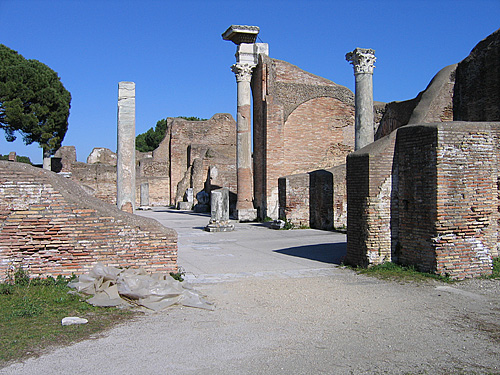
The Forum baths in Ostia are a perfect example of what a large thermae would look like. The rooms are preserved enough to see the original set-up and spacing of a bath. It was named for its proximity to the cities Forum and is a great example of why Roman engineers were experts at administering heat. A huge furnace heated both the water and air that flowed through pipes under the floors and into the walls in this bath. It is even evident I certain rooms of the bath house where there is a gap between the marble inside and the cement lining of the building were the hot would have risen to heat the rooms. This heating system is called hypocaust. These baths also included fine marble steps, which were perfect for lounging, conversation on the way toward the pools.
The octagonal room (for sunbathing) leads to the sudatoria (sweating room), then to tepidaria (where Romans were rubbed down by masseuses), and the once-steamy caldarium with three pools. “The frigidarium is conservative in its layout [compared to larger baths in Rome], with eight columns supporting a vaulted roof and cold plunges to north and south. However, the series of warm and hot rooms, which project boldly out from the lines of the old cestrum.” The sunbathing room is octagonal and presents four big windows to the afternoon sun, which, in the absence of heating pipes in the walls, suggests “that it was a heliocaminus or sun room of the type found at Hadrian's villa," (Frank Sear. Roman Architecture. 127).
The Bathing Routine
The term bathing routine is a bit of a contradiction because the Romans had no set routine when enjoying their baths. Any activity or room could be repeated, skipped or visited in a different order all depending on the desires of the bather.
The common day for a urban Roman began early with food and work until around two o’clock or the “8th hour” for men. Women on the other hand began their day with food and baths. The reason for this was mainly to avoid mixed bathing. While the men were working early in the day the women would be taking their baths and later in the evening men would attend to their baths and women would return home to prepare for guests. This would also be because in the mornings the baths would be just beginning to heat up, while by mid day when the men arrived the baths were at their optimal temperature.
The settings for most baths were very similar. There were smaller venues like the balnaes and larger, public thermaes. In even the simplest of baths you would encounter what is called the apodyterium, or changing room. Here people would often be accompanied by their slave(s) who would bring with them all the essentials for their time at the baths. This would usually consist of a change of clothing, oils, perfumes, sponge, towel and sandals, woodened with heels to protect the bottom of your feet from dirty water and over-heated floor and a strigil. A strigil is a metal rounded scrape, used to remove the dead skin from your body after it has been rubbed with oil and soaked in moisture.

While the baths were often thought to be a place of equaling among the classes, the number of slaves a person has present is usually what would separate the wealthy from the poor or middle class citizens. A person was able to rent slaves for their time at the baths or simply be served by the attendants, this is one of the only ways to separate one person from another.
The garments that bathers wore are still unknown. Unlike the founders of the public baths, Greeks, the Romans found it indecent to enjoy your bath in the nude. They often wore small clothes covering their lower halves much like a Scottish kilt, women were seen wearing something that is similar to a modern day tankini (Yegul, 35). Regardless of what social class you were in, most people wore the same attire to the baths.
Your time would begin with changing your cloths, which your slave would sometimes sit and watch to avoid common petty theft in the baths and also oil your skin before heading to the exercise portion of your activities.
The exercises that the Romans would partake in would not be what we, today, would consider rigorous by any means. The most rigorous activity the Romans would partake in would be boxing or wrestling but normally only until they broke a small sweat and then they would head to the bathing portion of their time (Yegul 36). Something that was thought as good exercise would be, “…reading aloud, walking, running, drilling and playing handball.” There would usually be a small to large courtyard where you would find people participating in these things and would hear the many noises of the baths, including the vendors selling and the yells of hair removal.
Many baths also had something called a natatio, a pool that was used for lounging, swimming and wading but not usually for serious lap swimming unless it was in one of the deeper pools. Yet the deeper pools were commonly used for Olympic training only. At the sound of the tintinnbulum bells, one would know, and often run towards the bath, as it was time to wash.

As mentioned previously, the order in which one would take a bath often differed depending on the bather, but the standard order started with some time in the Sudatoria. This room was used to encourage sweating and was kept at a relatively high temperature and very dry. Next one would continue to the Tepidarium, which was a bit smaller in size but the heat would increase as well as the moisture. The warmest room was the Caldarium, which was heated with hot baths, was wet and moist to wash the body. This is often were the scraping and washing of the skin occurred.
The furnace, which laid beneath the building, was slave ran with a large wood or coal-burning furnace. The smaller sized slaves, or young slaves, were the perfect bath heaters because their small frames would be able to fit into the confined space were the heating system was.
The frigidarium is the last place that bathers would enter. It was a cold pool that was used for a quick dive or splash to terminate the bath. To make sure that it was cooler then the other rooms it would often be the furthest room from the furnace, which was beneath the caldarium commonly.
In the tepidarium, caldarium, and lastly the frigidarium were, “ideal stages for traveling jugglers, gymnasts, conjurers, jesters, and musicians, “ (Yegul 39). They also offered food, and drinks including wine. They were often the perfect setting for vendors because large audiences used them at specific times in the day. Also many people believed that a “good bath called for a good dinner to make a perfect day.” (Yegul 39).
Baths and their Societal Impact
When baths were first introduced as a main part of urban society in the successful era of Rome they became an immediate success and a necessary part of the day. While previously it was common to bath only every week or so, when public baths came to fashion everything changed. It was something that all classes were fortunate to enjoy. Often times baths would cost as little as half a cent to use and others, the larger thermaes mainly, would even sometimes be free due to subsidizing by the government (Carcopino, 254). The wealthy or aspiring politicians could also pay to have the baths free for the day in honor of their name. This meant that along with the highest members of the Roman senate, commoners and certain slaves could even take part in the public baths.
Yegul discusses stories of emperors who would join his fellow public in the baths nearby. The emperor would then use this time to “appeal for public support and to increase popularity.” Because the baths were a community center at the time this would be like having a quick brunch with President Obama.
By creating these extravagant baths for the public, the emperor would be showing a great deal of generosity. The baths were very expensive to maintain. Besides the attendants and masseuses you also had to import all of the wood for the furnace from Tuscany. Water was also used in immense amounts, some baths were so large and so often used that they required their own aqueducts and the result was that more water per head was channeled into ancient Rome than is used in modern-day New York City.
While their masters would be leisurely enjoying a bath in the Forum or Neptune baths in Ostia, the slaves would be left to watch all of their belongs or used as attendants for the bathing process. Multiple bathhouses have found evidence in drawings that indicate slaves were able to use the facilities, it would have been a very rare occasion (Fagan, 200). The slaves that were caught while not guarding their master’s belongings would have been subject to punishments.
Another use of the baths, beyond cleaning and socializing was to better your health. Many doctors believed that the baths had a healing power on the body. With a short life expectancy in those times, many tried using the baths as a remedy for their illness. With this being said, there is no evidence toward separate baths for the sick. This caused for diseases to flow within the baths especially toward those who were careless with their sandals and their ending cleanse (Fagan, 85).
Unfortunately, baths were also known to attract some of the less pleasant aspects of society, such as prostitutes and acts of drunkenness and gluttony. Some people even went as far as having ‘love baths’ in which you could enjoy a “nicely cushioned couch and a lovely lady to love,” (Yegul, 42). This gave certain people a bad opinion of the baths, specifically when they saw their use as vain, over-consuming and used for reasons of lust or sobering from “indiscretion and indulgence” the previous nights (Yegul).
Thankfully for us, Ostia is still being excavated and with the help of more funds. Hopefully we will be to see more into the lives that Romans lived. So, while I do wish that we still had baths to enjoy today it might be something that is left in the past for our amusement. The baths tell us a lot about who the Romans were, how they lived to spend their days and also how interaction and communication were key parts to being a good citizen. Maybe we should take a note from their book.
Roman Baths, Book Bibliography
1. Balsdon, J.P.V.D. Roman Women, Their History and Habits. London: The Bodley Head Ltd, 1962. Print.
2. Carcopino, Jerome. Daily Life in Ancient Rome : The People and the City at the Height of the Empire. New Haven : Yale UP, 2003.
3. Conference, International. Roman baths and bathing proceedings of the first International Conference on Roman Baths held at Bath, England, 30 March-4 April 1992. Portsmouth, R.I: Journal of Roman Archaeology, 1999. Print.
4. Delaine, Janet. The Baths of Caracalla A Study in the Design, Construction, and Economics of Large-Scale Building Projects in Imperial Rome (Journal of Roman Archaeology Supplementary Series , No 25). Hettinger: Journal of Roman Archaeology, 1997. Print.
5. Fagan, Garrett G. Bathing in Public in the Roman World. New York: University of Michigan, 1999. Print.
6. Menen, Aubrey. Cities in the Sand. New York: Dial Press, 1973
7. Piranomonte, Marina. The Baths of Caracalla. Milan: Electa, 1998. Print.
8. Yegul, Fikret. Baths and Bathing in Classical Antiquity. New York: MIT Press, 1992.
Internet Bibliography
1. "Baths at Ostia - Ostia, Italy - Great Buildings Online." Architecture Design Architectural Images History Models and More - ArchitectureWeek Great Buildings. Web. 9 Jan. 2010.
2. "Ostia - Introduction." Ostia - Harbour City of Ancient Rome. Web. 6 Jan. 2010. .
3. "Ostia Antica: Baths of Neptune (Terme di Nettuno)." Italy: The Ancient Rome. Web. 6 Jan. 2010. .
4. "Roman Baths and Bathing (FalcoPhiles)." Marcus Didius Falco and Lindsey Davis Fan Site (FalcoPhiles). Web. 3 Jan. 2010. .